





For e-commerce businesses, choosing a delivery solution that suits both their products and their customers’ expectations is important. However, not every order needs to be delivered in the same way. For small, lightweight products in particular, there may be alternatives to standard parcel delivery.
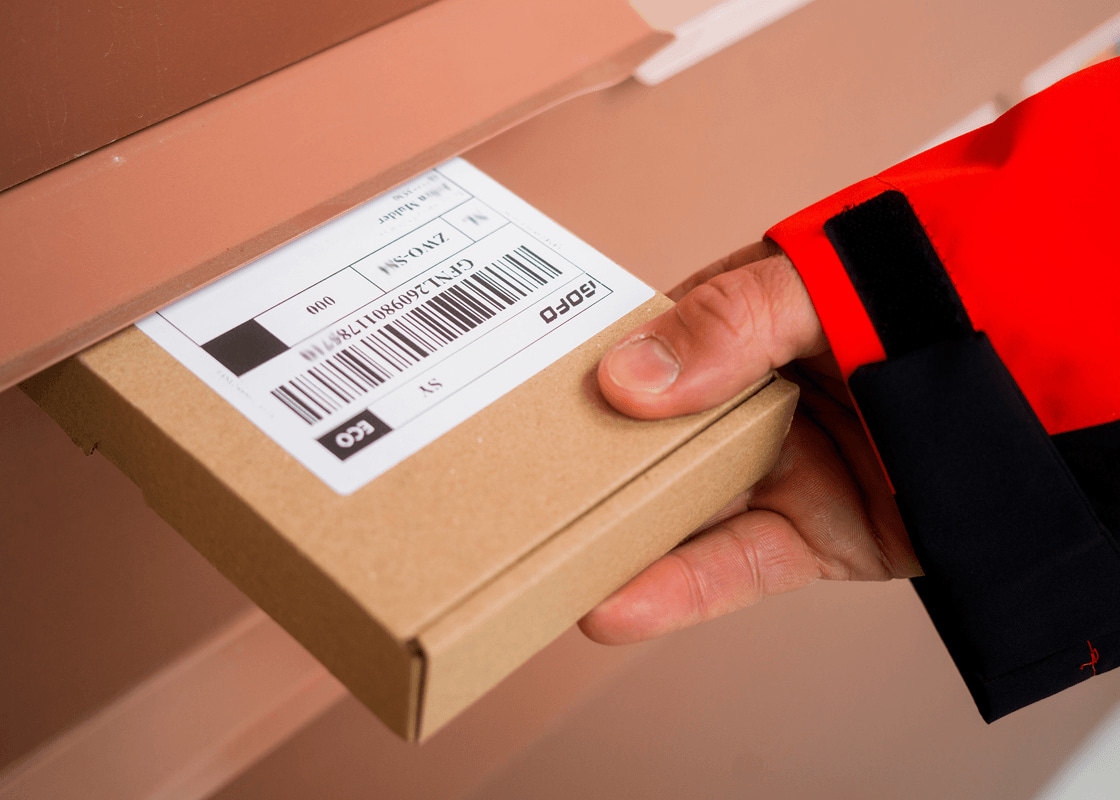
Mailbox parcels are one such option. Eligible orders can be delivered directly through the recipient’s letterbox, without requiring them to be at home. This offers greater convenience for consumers while giving e-commerce businesses an additional delivery option for compact shipments.
Whether an order qualifies for this service depends not only on the product itself but also on its packaging. The final dimensions help determine which delivery options are available. Packaging design therefore becomes an important consideration when balancing delivery convenience, operational costs and efficiency.
What is a mailbox parcel?
A mailbox parcel is a compact shipment that can be delivered directly through the recipient’s mailbox. This means the recipient does not need to be at home, and no personal handover is required. Maximum dimensions and weight limits vary between delivery providers.
Why is a mailbox parcel convenient for recipients?
Standard home delivery sometimes requires the recipient to be present. Academic research on B2C last-mile logistics describes how customer absence can contribute to failed delivery attempts, with potential consequences for operational costs and customer satisfaction.
For eligible shipments, mailbox delivery offers a practical solution to this issue. Since the parcel can be delivered directly through the mailbox, the order can reach the customer’s home address without requiring them to wait for a courier.
This is relevant in a market where consumers increasingly expect delivery to fit around their daily lives. According to the DHL E-Commerce Trends Report 2026, based on research involving 29,000 online shoppers across 29 countries, home delivery remains a popular choice. In Europe, 60% of consumers prefer home delivery, compared with 77% in the Netherlands.
At the same time, consumers also use alternative delivery options: 49% of European consumers redirect parcels to an out-of-home location, while 40% have orders delivered directly to such locations.
These figures do not specifically measure demand for mailbox parcels and represent different aspects of delivery behaviour. However, they illustrate that both home delivery and flexibility influence consumers’ delivery choices. Collection points and parcel lockers offer flexibility but still require customers to collect their orders themselves.
For eligible products, mailbox delivery combines both benefits: the order is delivered to the customer’s home without requiring them to wait for a courier.
However, this convenience is only possible for shipments that physically fit through a mailbox. For e-commerce businesses, the decision therefore begins with the dimensions of both the product and its packaging.
When is a product suitable for mailbox delivery?
Whether a product is suitable for shipment as a mailbox parcel depends not only on the size of the product itself but also on the complete shipping packaging. The product must be adequately protected, and the packaged shipment must meet the delivery provider’s size and weight requirements.
For GOFO Mailbox Parcel in the Netherlands, the maximum dimensions are 38 × 26.5 × 3.2 cm, with a maximum weight of 2 kg. During sorting, shipments are automatically measured and weighed to verify that they meet these requirements.
How does packaging affect mailbox delivery eligibility?
Consider a product that is only two centimetres thick. On its own, it can easily fit through a mailbox. However, placing the same product in a shipping box that is six centimetres thick may make it ineligible for mailbox delivery.
The additional packaging changes not only the parcel’s dimensions but potentially also the delivery options available for that order.
For businesses shipping large volumes of compact products, this difference can be relevant. By analysing the dimensions of their existing shipping packaging, they can assess whether some orders could qualify for a different delivery service.
This does not mean that mailbox delivery is automatically cheaper than standard parcel delivery. Actual costs depend on factors such as shipment profiles, shipping volumes, packaging and commercial agreements with the delivery provider.
Packaging optimisation can therefore deliver benefits beyond reducing material use. It can also help businesses make more informed decisions when choosing between different delivery options.
What does the PPWR mean for e-commerce packaging?
The European Packaging and Packaging Waste Regulation (PPWR) has applied since 12 August 2026 and introduces new requirements for packaging and packaging waste across the European Union.
Article 24 is particularly relevant for e-commerce businesses. This provision establishes a maximum empty-space ratio of 50% for certain packaging types, including e-commerce packaging, subject to applicable exemptions. This obligation applies from 1 January 2030 or three years after the relevant implementing acts enter into force, whichever date is later.
The PPWR therefore highlights the importance of packaging that fits the contents while maintaining adequate product protection. This aligns with the considerations e-commerce businesses face when balancing product dimensions, packaging design and available delivery options.
How can businesses track and verify mailbox parcel deliveries?
Beyond parcel dimensions and packaging, the delivery experience is another important consideration when choosing a mailbox parcel.
Because a mailbox parcel does not require a personal handover, the recipient’s absence does not prevent eligible shipments from being delivered. However, other delivery issues, such as an incorrect address or an inaccessible mailbox, may still occur.
For delivery without a personal handover, it is particularly important for e-commerce businesses to be able to verify the delivery. GOFO Mailbox Parcel combines the convenience of mailbox delivery with real-time track & trace and two photos as Proof of Delivery (POD). This allows the delivery to be documented with photos, even for mailbox shipments.
Businesses can therefore track the delivery status and access additional information when customers have questions about their orders. While POD cannot prevent every delivery issue, it can help verify the delivery and investigate potential delivery questions or disputes.
For e-commerce businesses, choosing a delivery solution therefore involves more than parcel dimensions and shipping rates. Recipient convenience and access to delivery information are also important considerations.
Smarter delivery for compact e-commerce shipments with GOFO Mailbox Parcel
For e-commerce businesses that regularly ship small, lightweight products, smart packaging choices can create additional delivery opportunities. By considering the dimensions of fully packaged shipments, businesses can determine which orders are suitable for mailbox delivery.
GOFO Mailbox Parcel provides a business delivery solution for these shipments in the Netherlands. The service supports parcels measuring up to 38 × 26.5 × 3.2 cm and weighing up to 2 kg, with nationwide coverage. Eligible shipments handed over before the agreed cut-off time qualify for next-working-day delivery, from Monday to Saturday.
By combining home delivery without personal handover, real-time track & trace and photographic Proof of Delivery, GOFO Mailbox Parcel combines convenience for recipients with visibility over the delivery process for businesses.
For e-commerce businesses looking to optimise their packaging and shipping operations, GOFO Mailbox Parcel can be a suitable complement to standard parcel delivery.
Explore the possibilities of GOFO Mailbox Parcel
Want to find out whether your e-commerce shipments are suitable for mailbox delivery? Explore GOFO Mailbox Parcel or contact our sales team to discuss the options available for your shipping profile.