





A new school year means new routines and a long shopping list to match. From textbooks and trainers to laptops, headphones and sportswear, Back-to-School has grown into a shopping moment that reaches well beyond the stationery aisle.
Recent data from several European markets reveals three shifts worth watching and what they could mean for e-commerce retailers as orders move from checkout to the doorstep.
Bigger budgets, more selective shoppers
Back-to-School spending is rising in several European markets, but the numbers tell a more complicated story than stronger consumer demand.
In Spain, planned Back-to-School spending reached €478 in 2026, up 12% YoY. Yet 28% plan to spend less, while 69% of those spending more blame higher prices. In France, the average budget rose to €488, up €79 from 2025, even as 69% of parents say they need to tighten their budgets. In Germany, 47% of parents feel financially squeezed by summer holiday and Back-to-School costs, while 47% of consumers look for special offers.
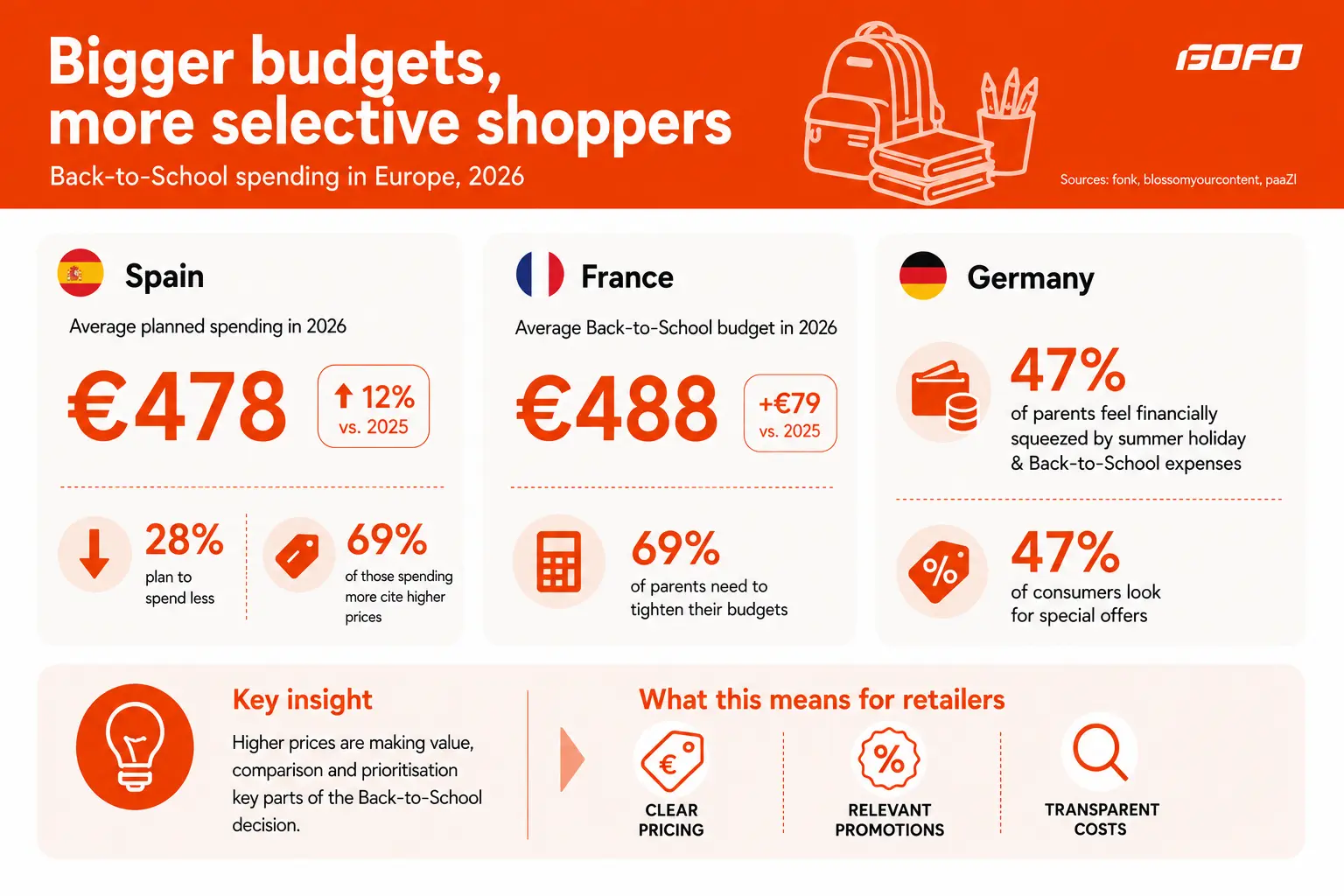
Taken together, the message isn’t simply that Europeans are spending more. Higher prices are making value, comparison and prioritisation increasingly important parts of the Back-to-School decision.
The school shopping list is getting broader and more digital
The traditional image of Back-to-School shopping may be notebooks, pens and textbooks. The actual basket looks considerably broader.
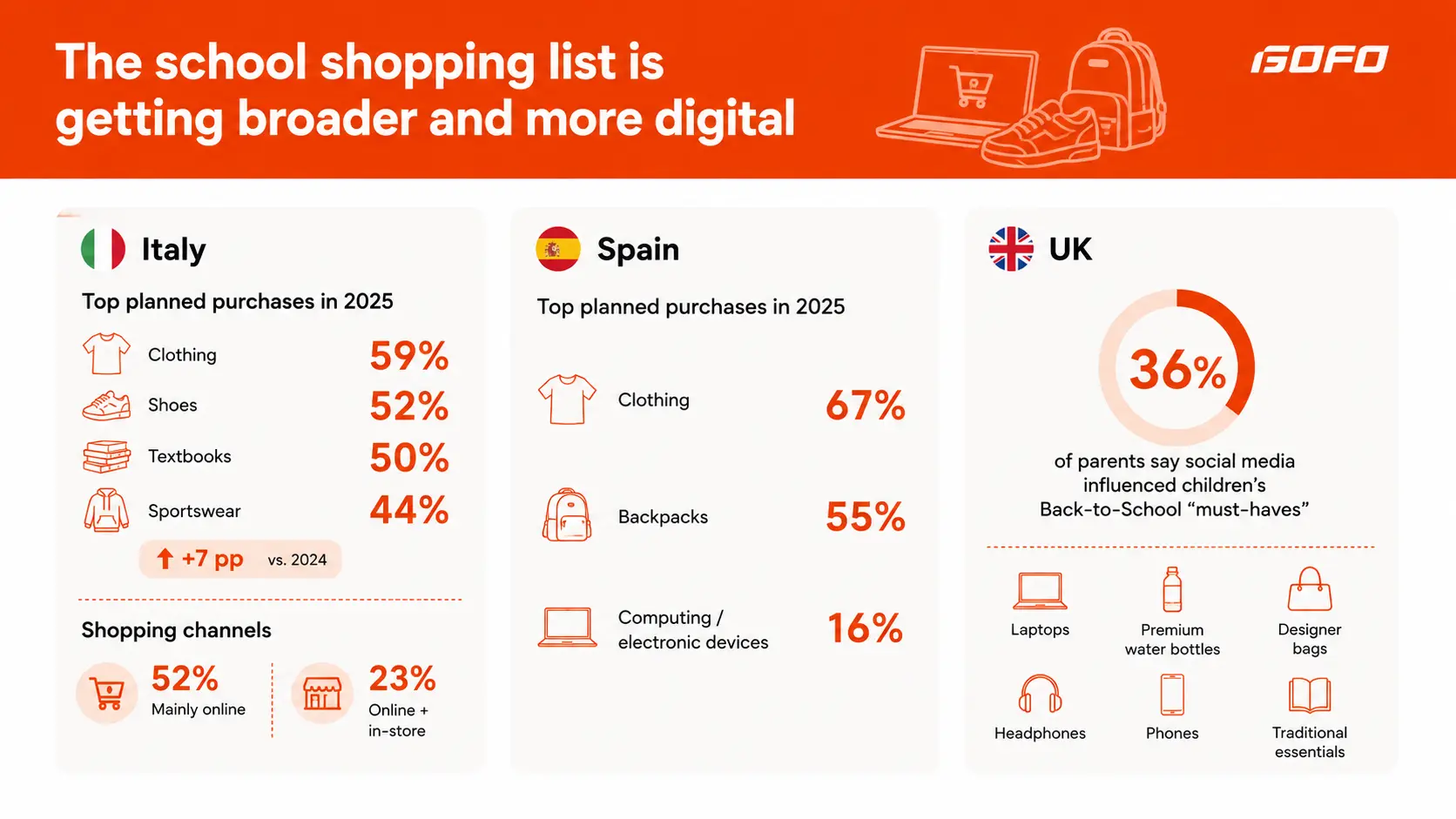
In Italy, Back-to-School is moving well beyond school supplies: 59% planned to buy clothing, 52% shoes and 44% sportswear, while 52% planned to shop mainly online.
Spain shows a similar pattern, with 67% buying clothing and 55% backpacks.
In the UK, 36% of parents said social media influenced children’s Back-to-School “must-haves”, from laptops and headphones to premium water bottles and designer bags.
These are different national markets, but together they illustrate a broader opportunity: Back-to-School increasingly touches fashion, tech, sports and lifestyle and the journey between inspiration and purchase is increasingly digital. For e-commerce retailers, that opens the season to far more categories than those traditionally labelled “school supplies”.
Value doesn't always mean buying new
The pressure on household budgets is also changing how some European families shop.
In France, 41% of parents plan to buy second-hand for Back-to-School in 2026, up eight percentage points from 2025, while 44% plan to reuse items they already own.
Italy shows similar behaviour around textbooks. Research from Altroconsumo found that more than half of surveyed families with secondary-school children bought at least some textbooks second-hand. Saving money remains the main motivation, but 46% of second-hand buyers also cited reducing waste and environmental impact.
Spain adds another signal: among consumers planning to reduce their Back-to-School spending, 36% intend to reuse existing materials and 33% plan to shop second-hand.
Across these markets, circular consumption isn’t replacing new retail. But it is becoming another way consumers balance cost, usefulness and sustainability during a financially demanding season.
From checkout to the last mile
For Back-to-School purchases, timing matters. A backpack or laptop arriving after the first day of school can quickly turn a successful sale into a poor customer experience.
And delivery expectations start before checkout: 48% of European online shoppers have abandoned a cart because of delivery-related issues, while 76% prefer stores that show a specific delivery date at checkout. Interestingly, 76% are also willing to wait longer to avoid delivery fees showing that certainty, choice and value can matter just as much as speed.